
Read Conecuh County Property Tax Record Fields
Start with the CAMA card. The Revenue Commissioner's card is the strongest first source for Conecuh County property tax records, pairing owner text and parcel identifiers with situs and mailing addresses, deed reference, acreage, district, and exemption code. Values come with it too. Depending on the parcel, the card lists land and improvement values, a total appraised display, the annual tax, and payment history. Read each amount beside its tax year.
| Record field | Meaning | Official source |
|---|---|---|
| Land and improvements | Separate parts of the appraised display | Revenue Commissioner CAMA |
| Total appraised value | County valuation before class ratio and relief | Revenue Commissioner CAMA |
| Exemption code | A flag that needs an eligibility cross-check | CAMA and Alabama DOR |
| Annual tax and history | Yearly charge and, on some cards, past payments | CAMA or county tax service |
| Tax district | County or municipal tax context | Revenue Commissioner CAMA |
An appraised label is not a sale price. Public examples show a last deed book, page, and date with no confirmed consideration amount. Annual tax is not value either. It reflects classification, assessment rules, exemptions, rates, and the account's status for the year shown.
Alabama Ratios Shape Conecuh Property Tax
Alabama property tax starts with appraised value. A class ratio then produces assessed value. The Alabama Department of Revenue sets the ratios. Class I utility property sits at 30 percent and Class II property generally at 20. Class III agricultural, forest, residential, and historic property sits at 10 percent, and Class IV private passenger vehicles at 15. Know the class before reading any assessed figure.
Current-use land can get separate use-value treatment. Conecuh's public land-search form includes current-use and homestead fields. A search flag decides nothing about eligibility. Ask the appraisal office how the parcel is classified and which year the card shows. That habit prevents applying a residential ratio to business property or comparing assessed value straight against the appraised total.
Conecuh Property Tax Value Layers
Official sample cards make the layers concrete. The Pate card lists $38,000 in land, $6,500 in improvements, a $44,500 total appraised value, and $176.64 in yearly tax for 2025. The Sessions card shows $72,500 in land, $85,500 in buildings, a $158,000 appraised value, and $729.57 in yearly tax. Two parcels, two layouts. Neither is a countywide benchmark.
The Watson result adds a third arrangement, with land, improvement, total market or appraised display, acreage, deed book and page, exemption code, and yearly tax on a single row. That inventory helps identify which number is which. It cannot estimate a different parcel. And the deed date beside the values establishes no sale price.
Look Up Conecuh Property Tax
Identify the parcel first. Use the Conecuh public CAMA form to find the parcel and its assessment card. The county's online-services landing page offers a View/Pay Property Taxes path, though it publishes no direct tax-bill endpoint. That vehicle-renewal fee is not a property-tax fee.
- Search the physical address, owner, PIN, account, or full parcel segments and open the matching card.
- Confirm the situs, acreage, district, deed reference, value year, exemption code, and annual tax.
- Use the county View/Pay Property Taxes route to check the live amount and payment status.
- Compare a past-due claim with payment history and the state delinquent-tax transcript.
- Call the Revenue Commissioner when the endpoint fails or a field appears stale.
- Appraised value
- The county's full valuation display before a class ratio.
- Assessed value
- The figure after the applicable Alabama classification ratio.
- Homestead exemption
- Qualified relief associated with an eligible homestead category.
- Tax lien
- A legal claim tied to unpaid tax, distinct from a routine annual charge.
Start a Conecuh Property Tax Search
The captured Conecuh County online-services page provides the official handoff to View/Pay Property Taxes.
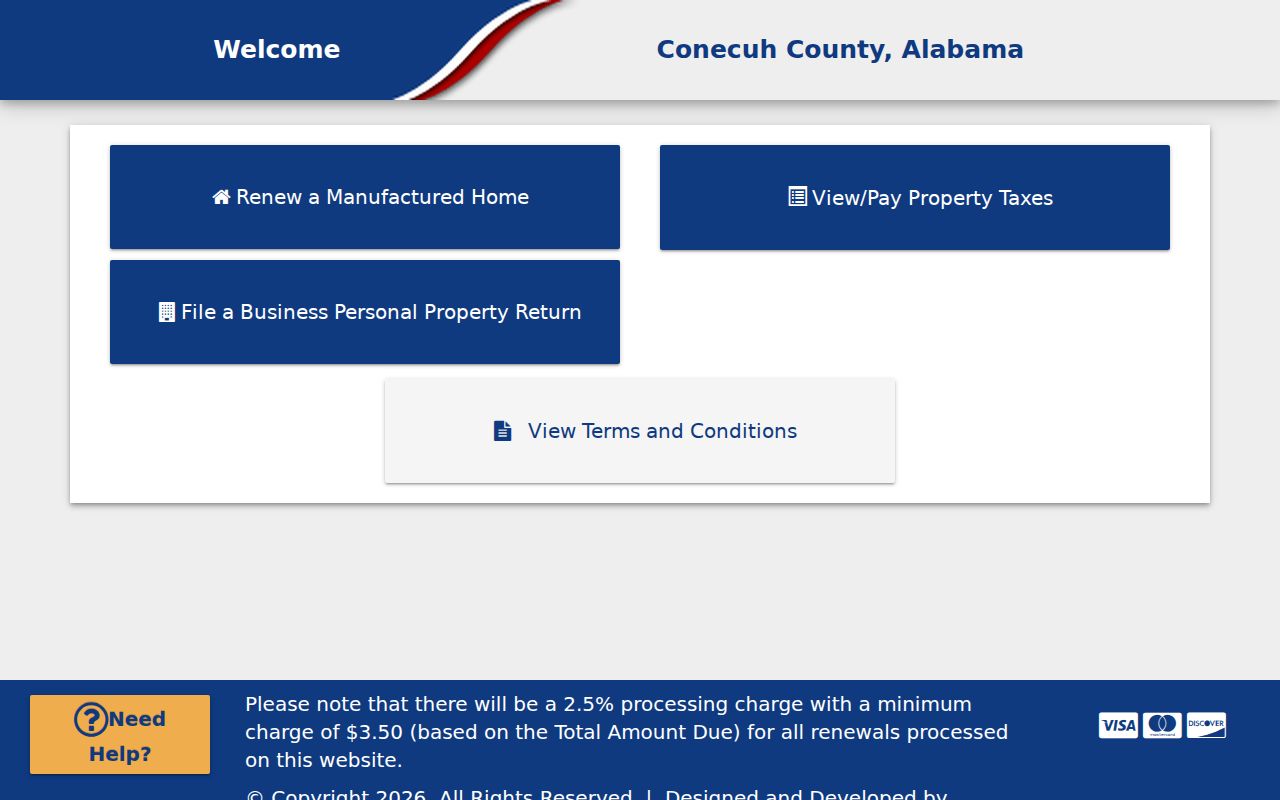
The landing screen confirms the access route. The final balance comes from the live tax service, and a fee stated for another transaction never establishes a property-tax fee.
Check Conecuh County Property Tax Exemption Codes
CAMA exposes an exemption code on the card. Alabama DOR defines four homestead categories, H-1 through H-4, each with its own rules. A code is only a clue. Eligibility depends on the category and the owner's facts. An omitted or unexpected code belongs at the Revenue Commissioner's appraisal office, not inferred from a neighboring parcel.
That office sits with Revenue Commissioner Jimmy Bell at 111 Court Square in Evergreen, reachable at 251-578-7019, while the appraisal line is 251-578-7026. Ask which exemption appears on the current roll. Ask what proof is needed and when a change will post. The county publishes no separate exemption form or local calendar, so treat any deadline as unconfirmed until the office states it.
Conecuh Property Tax Dates and Cap
Alabama DOR sets the calendar. Property taxes are due October 1 and turn delinquent after December 31. Annual reappraisal reviews one-fourth of each county, and owners report additions or removals by December 31. The live Conecuh account still governs the current charge and status.
Act 2024-344 added a cap. Qualifying increases in taxable value for Class II and Class III real property are limited to 7 percent a year. Ownership changes and certain improvements are excepted. The cap is not a freeze. It does not erase the tax. It never converts an appraised figure into a sale price, so compare classification, exemptions, ownership changes, improvements, and the field the cap actually touches.
Cross-Reference Conecuh County Property Tax-Sale IDs
The Alabama DOR delinquent-property page posts transcript links for each county and refreshes them weekly. The Conecuh transcript carries a date of August 28, 2026. Each line shows names and bid amounts. It also lists county and year, certificate or sale number, class or code, parcel ID, and legal-description text. No street address appears anywhere in it. That gap matters, because a parcel number is the thread that ties everything together. Start with the parcel ID and legal description. Match them in CAMA, then cross-check the Probate land index and the tax service. One CAMA record embeds "TAX SALE 2019" in the owner field. It also lists a second party. Raw owner text can describe a status rather than a person. Confirm the record before claiming who holds the tract now.
Protest a Conecuh County Property Tax Assessment
An owner who disagrees with a valuation can push back. Alabama law allows a written protest to the county Board of Equalization within 30 days of the valuation notice. Conecuh County publishes no appeal form or hearing calendar of its own. Before the deadline, the Revenue Commissioner's office can confirm the notice date, the filing address, and the current hearing steps.
Appeal window. The documented statewide period is 30 days from the valuation notice; verify Conecuh filing details immediately.
Anchor the case in specifics. Cite the parcel number, the tax year, and the exact field in dispute. A wrong physical fact, such as bad acreage or a miscounted structure, calls for different proof than simple disagreement over value. For factual errors, the notice, the CAMA card, photos, and correction evidence usually settle it. A deed can back up acreage or ownership. A licensed appraisal speaks to worth, and genuine comparable sales help too. File on time and keep the receipt. Request a written result. For help with valuation labels see the Conecuh County property value guide.